Tuesday, November 12, 2013

Two Envelopes Paradox

Just for spice, let's look at academic philosophy getting it right.
"We want to compare the amount that we would gain by switching if we would gain by switching, with the amount we would lose by switching if we would indeed lose by switching. However, we cannot both gain and lose by switching at the same time. We are asked to compare two incompatible situations." 
And yet,
"God help us if, after the fourth round of drinks, someone brings up the two envelopes paradox." (Here, via
La Wik's phrasing needs work, so in my own words:

When first looking at switching, it seems I must switch, as the expected payoff is 5/4 A. However, now I've switched, I can't re-define the amount in the new envelope as A - it's still 5/4 A, and thus switching back must be a loss. At first this feels like I've unjustifiably broken the symmetry - before I pick an envelope, the expected value must be equal - but since I've added an assumption asymmetrically, it would instead be weird if the symmetry remained.


The second version, where I actually open the envelope, also breaks the symmetry. Sadly this one is still best analyzed by throwing all the academics in a lake.

Your daughter has some terrible eye-melting but curable disease, and you are poor. The opened envelope has $10 000 in it. Do you switch? Obviously not - it's not risking five grand, it's risking your daughter.

Your daughter is fine. You're thinking of buying a new car. The opened envelope has $10 000 in it. Do you switch? Obviously so - no matter what, you get a nicer car, we're just haggling about whether you also get to pad your retirement fund.


Seems clear to me. But why the lake? Have fun trying to find even one academic who will make this clear. The real world and applications are low status, don't ye know.

Second, I've tried to respect intuition. Nobody analyzes these things entirely abstractly. It is passed to the subconscious and the subcon uses concrete examples, usually whatever the availability bias spits out. (E.g. think of a cat - no no, not a cat with fur, an abstract cat. [Mine's an adult tabby. {Side view, facing left, tail erect, front right paw (white) lifted, looking a bit surprised.}]) This will naturally lead to very different intuitions based on things like how rich you currently are or how secure you currently feel.

Additionally, expected value is not the whole story, and one other consideration is whether you can absorb the possible loss. Your intuition will consider this and you can't tell it not to without training.


Completely unrelated, this article taught me a new rule of thumb. "Though Bayesian probability theory ..." The translation: "We are now going to talk out of our ass." Any paragraph or section explicitly calling itself Bayesian is not worth reading. Presumably one calling itself frequentist would be just as bad, but I haven't seen one of those yet.

Sunday, November 10, 2013

Self-Reference, Logical Positivism, and Existence

It would appear Reality wanted to spot-confirm my hunch, as per my last post, that respect for self-reference is too high.

Logical positivism has been discredited by feeding itself to itself.
"Logical Positivism is the view: "The only meaningful statements are those that can in principle be verified empirically.  Logical Positivism fell because it cannot itself be verified empirically thus it is meaningless by it's own standard."
Or what I found:
"Therefore, LP is meaningless. I don't know what you mean when you say that meaning can only be ascertained by the possibility of an experiential proof as that statement has no possibility of an experiential proof." [1]


Let LP be f(proposition) = 1 if proposition is meaningful, and 0 otherwise.
Solve for x: f(LP) = x.
Substitute f(proposition) for LP, but proposition = LP, so f( f(LP) )) = x. Et cetera.
In other words, Green, Brown, and everyone who thinks like them have made a critical logical misstep when they concluded that LP self-disproves. Properly appreciated, the argument looks like this:
  • Assume LP
  • biowhjtn4ali;buah.wevkjask;rbhafb
  • Therefore, f(LP) = 0. 
  • Therefore, by contradiction, LP is false. 
This doesn't prove that LP is not meaningless. Similarly, Godel's first incompleteness theorem is true, despite having a faulty proof. A system cannot prove its own consistency, as that would be circular reasoning - and it cannot prove its own inconsistency, either.

I'm not a logical positivist and had to look this stuff up. Instead I believe something, generalized from my formal study of physics, that can apparently be confused with logical positivism. I believe existence is defined by interaction.

As it can be confused with logical positivism, I can be certain LP should have been repaired, not discarded, and as a result this corner of philosophy has been in a blind alley for several decades.


It has come to my attention that philosophers don't understand existence. Let's pretend I can change that.(Again. [2])

Because a system cannot prove or disprove itself, we can be certain that we need an external framework to evaluate any system, and the framework will necessarily be strictly more powerful, as it contains the system in question. The problem is there's a strictly most powerful framework: existence itself.

We can be certain of this even using only diction. Look at how I must start the proof: if a strictly more powerful framework than existence existed... I call this the principle of existence. It seems to have the property of being self-justifying, indeed it seems that a self-justifying framework can be defined as existence.

Though proving this is impossible.

First problem, existence is the most powerful framework. Second problem, since everything is subject to the principle of existence, logic is inherently less powerful than existence. Existence is the framework by which I evaluate logic; it is not valid to use logic to evaluate the statement 'existence is the most powerful framework,' or that 'existence is self-justifying.' (It bemuses me that I can even state or communicate the idea.) Conversely, I can't use logic to invalidate the ideas either, and both these restrictions also apply to evidence.

So, have I tried to put 'existence is interaction' though the wringer of itself? I have. I found it's a bit stupid and felt silly.

Despite this, I will pretend to argue for it. If you can figure out how this relates to the fact that arguing is invalid, kindly let me know. (I'll probably understand eventually, but it would be nice not to have to do it all myself.)

Because it isn't an argument, it isn't unreasonable to hold a contradictory axiom. However, it is unreasonable to think any alternative can be logically defended.


The purpose of truth is prediction. I don't really care about truth per se, I care that when I go to make tea, the tea leaves and hot water are where and how I think they are. The purpose of prediction is to control my own subjective state. (How this invalidates caring about BIVs and the external world is left as an exercise.) For example, being able to experience tea when I want to experience tea. As another, experiencing nourishment so that I don't experience starving to death and thus termination of experience. Truth allows me to predict and thus fulfil these goals.

Something that cannot interact with me cannot affect my goals. If it cannot affect my goals, as far as I'm concerned, it does not exist.

Nevertheless, existence is the ultimately axiomatic axiom. As it's not an argument, this is a suggestive story. (Mmm, tea.)


Ironically, Brown says, "it is the hope and intent of this work that once people come to really understand Hume and the Bullshit Nature of Rational Philosophy, they can start working on an axiomatic philosophy," apparently unable to see that LP only functions as an axiom.

Rack this up as another place where philosophy has gone off into the weeds so deeply that a single individual can outflank the entire academic class. Of course, I don't actually think I have some superhuman insight. I think anyone can do this if they have enough dedication. It's a process of discarding chains more than acquiring skills, and not giving up by concluding it must be impossible. Having a PhD in philosophy is such a massive millstone that even the middlebrow can pass them if they set their mind to it, and lesser qualification are merely lesser millstones to be overcome. 


In this case, I apparently independently re-derived a better version of logical positivism. (I certainly didn't read any Wittgenstein or Russell.) I can tell because my phrasing is different and the logical geometry is just a bit off. Sadly you can't tell - I might have deliberately rephrased it specifically for the purposes of foisting this metric off on you. But, were you to embark on a similar expedition, you know what to look for in yourself.

By the geometry, I mean I don't seem to need empiricism or meaning as concepts. If they appear, they appear as consequences of the principle, rather than having to be injected. Interaction-existence and LP as concepts can't quite be superimposed neatly. I don't use the idea of statements either, and though I tend to have to add that to get any use out of interaction-existence, because it isn't native it becomes modular - if you don't like statements and can come up with an alternative, it works fine.


[1] Careful, Brown's mean free path between contradictions in this piece is maybe 20. Go here if you want to see him inside his domain of expertise. It's the detail view of what Moldbug mentions about models. In the LP piece, roughly all the implications he ascribes to LP are embarrassing misunderstandings. Or sheer mendacity - I found one insult he flings that he later straight-up contradicts the basis of. Unfortunately, this sort of thing seems typical of modern academics.

[2] I like repeating myself, because if I've made a mistake, every repetition increases the likelihood I'll make a different mistake which will show up as a detectable contradiction. It also allows the reader to do logical diffraction if I'm correct: each slightly different iteration has slightly different interpretations, and you can eliminate the possibilities that don't overlap and reinforce.

Tuesday, November 5, 2013

Self-Referential Sentences such as the Liar Paradox

I appear to have a novel solution.

In mathematics, some numbers may be consistently defined recursively, though they must pass convergence tests. In logic, it seems convergence is impossible.

Let f(x) = 0 represent 'this statement is false.' To resolve what it means, I must substitute the statement, 'this statement is false' into 'this statement,' or f( f(x) ) = 0. Trying resolve this new statement, I get f( f( f(x) )) = 0. And so on.

The liar paradox is not a statement. It is nonsense. It can be neither true nor false.


As I've mentioned before, I should not be able to outflank the whole of professional philosophy. Their combined brainpower should find all the solutions my single brain can, just by chance. Their mistakes alone should outweigh my contribution, even if they had systematic bias against it.

Considering that both Godel's incompleteness theorems and the halting problem proof depend on these kinds of non-resolvable statements, I expected scholars to at least address the objection in passing. I expected to find I took the idea more seriously, not that I am apparently the first it has occurred to.

Explaining this bungle demands some strange ideas. Do I have superhuman insight, or are professional philosophers capable of seeing the real solution well enough to avoid it?

Monday, September 16, 2013

Sophist Theory Predicts No Enemies to the Left

Jim describes how proggies will betray anyone to the right of them, and will happily lay down to be betrayed by those to the left. Or equivalently, that the holier should rule - should rightly enslave, really - the less holy.

Sophistry is the art of using the tools of philosophy to gull those dumber than you into believing lies that empower you. This implies a clear linear hierarchy. Lesser sophists, dumber, more gullible, less sophisticated, are pwned by greater sophists. The lesser sophist's use of the framework essentially backdoors him; he cannot credibly say even to himself that that the greater sophist is objectionable without also condemning his own actions. (As opposed to e.g. a warrior hierarchy, where lesser warriors gain skills to better resist greater warriors, if necessary.)

Similarly, it is probably consistent with Jim's observation that elite leftists appear dumber. Those higher in the sophist hierarchy will tell a wider variety of more complicated lies. In other words, they'll be wrong more often.


Here's an interesting wrinkle about who rules whom: who gets to decide what's holy? Who gets to decide what is most leftward in Jim's left-right definition?

Saturday, August 17, 2013

Juxtaposition IX: Attention Psychology


Last Psychiatrist: (Via: 1; 2; 3; 4.)
Negative affect has long term consequences, duh, but short term no affect is completely intolerable. Observe (start at 25s):
The temptation is to view the baby as upset, but in fact what he is doing is trying anything to get her attention, including screaming. This is why what he is is frustrated, and why it is called acting out.


Foseti:
This dumb statement is huge news because the player is white [...] The following crimes are (by this metric) less noteworthy than a racist statement (the utterance of a word) [...] child abuse, gun possession, DUI, drug possession, missing a court date, stealing from a casino, public intoxication, resisting an officer, assault, battery, disorderly conduct, resisting arrest, fighting, solicitation, street racing, and (last but certainly not least) attempted murder.


Also worth considering: given no affect, what does the baby conclude about themselves? Children have a disturbing tendency to think what does happen to them is what should happen, and reason accordingly.

Monday, August 5, 2013

AutoEngineering: I Turned Off My Psycho-Social Development

In adolescence I noticed I was becoming extra susceptible to conditioning, and that school was aggressively trying to condition me.

This post is subject to editing, because I don't know if I'm getting my point across or not.


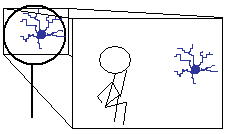
It felt roughly like this. I don't know why it looks like a tumour. Also the feeling was slightly outside my skull.

I knew I was being conditioned because I noticed my natural reactions getting changed. (Sadly, I forget which reactions.) I knew it was due to highly impressionable psycho-social development because the feeling of being conditioned was very similar to the feeling of thinking about dealing with the other students.

I still wanted good grades (foolishly) but rather objected to being conditioned.

So I willed it to stop. I recalled the feeling of the network, and added the idea of eye contact to get it to sit up and pay attention. I imagined myself telling it to shut down. It did. 

Once I escaped school, I needed to get it to wake up again. 


I repeated the recall image and then nudged it awake. 


It turns out you can in fact delay developmental benchmarks if you want. The downside is you need to know, as a stupid kid, which benchmarks to play around with. I got lucky with this one, I broke some things playing around with this.

Wednesday, July 24, 2013

Big Bang is Unphysical

I've worked out how to articulate the problem with the Big Bang theory.
"Extrapolation of the expansion of the Universe backwards in time using general relativity yields an infinite density and temperature at a finite time in the past."
Works out fine working backwards. It's not-infinite in the moment before it gets infinite, and being compressed. Well, works out enough, I suppose.

The problem is going forward. How does the infinite state know it is supposed to become not-infinite? How does it run out of energy? The past doesn't know the future. Mathematically, infinities can't know how big they are. Technically speaking, math never deals with infinities per se, but with limits. Problem is, an infinite physical state can't use l'Hopital's rule on itself. It doesn't know what function it is the limit of. Which means it's not the limit of a function, but a real, honest-to-goodness infinity.

Or, put another way, when your model assumes the infinity is the limit of some function, I can counter with an identical particle that's the limit of some other function, which is the classic test of 'undefined' in mathematics.

Which means it can't run out. An infinite state should stay infinite forever.

Or, it is strictly speaking undefined.


I should stress I have no real issue with the Bang in general terms. However, specificity is critical to physics. Fixing this infinite is likely to have wide-ranging consequences, not at all subtle.


Hopefully a theme is becoming clear: physicists do not think about their theories anymore, and it is causing serious issues. They do the math, trust they've done the right math, and haven't.

Wednesday, July 3, 2013

Progressivism Diagnostically

This post is subject to updating.
July 5: bit about the host's flaws constraining the rulers.


Progressivism is an atheistic religious cult bent on political domination for the purposes of parasitically living off the host culture.

I'm about the call the host culture shallow, easily manipulated, and gullible towards even mediocre authority. Possibly I'll also reference that its historical literacy is negative, that curiosity is slightly frowned on, and that two of the most respected kinds of jobs are politicians and actors - both of which have 'excellent liar' on the want ad.


Progressivism uses lies/bullshit and social pressure to spread behaviours that uphold progressive power structures. As a result, while Progressivism is historically rooted, proximally all of its professed beliefs are those which support its own power.

For example, Progressivism thought of vegetarianism because it is a child of Puritan Protestantism, which hates the idea that anyone might be enjoying themselves, because they're sure not. But, it amplified/bandwagoned and upheld vegetarianism because meat is warrior food. Meat promotes honour, independence, and self-reliance by supporting the underlying endocrinology. As another example, Progressive's atheism most likely stems from the injunction about separating church and state. Much easier to pretend not to be a church if nobody goes to church, rather than trying to reverse the injunction. 

Progressivism exploits the limited inferential distance of the layhuman. For example, it supports lies by opposing it to a more obvious lie.

Creationism. The Progressive take on evolution would be autoaphyxiating if they seriously believed it. However, it is portrayed as the alternative to creationism. Creationism seems obviously crazy; Progressive evolution, only crazy once you think one or two implications down the road.

Progressivism uses emotional vulnerabilities. Using rhetoric, sympathy is spun into power. Using rhetoric, power anoints the sympathetic. The ruler who rules for the downtrodden is considered legitimate. Even if the downtrodden are made worse off, as is the case.

The poor were once a useful club to beat various groups with. Now they're not, so their sympathy status was revoked and given to somebody else. 

Women were not historically oppressed. Women had a set of imposed obligations that matched the obligations men had to care for them. However, "That's mean to girls!" is a highly sympathetic statement, and so now women are so privileged in divorce court that no man would marry one unless they absolutely have to. (I exaggerate. Slightly.) 

See also: China aborting girls. Because pensioners are legally obliged to support their unmarried daughters, whereas sons are legally obliged to support their parents. Attempting to privilege women falls afoul of market effects and game theory.

It doesn't matter whether 'for the downtrodden' is a good idea or even possible. It doesn't matter who in fact deserves sympathy.

For the layhuman, that they feel sympathy is strong evidence that sympathy is deserved. Having to admit a mistake is much worse than sympathetically supporting or sacrificing to someone undeserving.

Progressivism has successfully appointed itself arbiter of evidence. Any fact contrary to its pathetic rhetoric can be suppressed by fiat.

It is not only by inspection that we know that men are different from women, we know it scientifically. (Via.) This paper will of course never be mentioned in any American Empire newspaper, and I highly advise you to not bring it up at the watercooler. If it does somehow get a public showing, it will be denounced as crimethink, and a combination of loyalty and fear will immediately send it to the memory hole. 

Tragically for science, what these differences mean, in terms of face-to-face and lifelong outcomes, will not be investigated. Presumably some male-female difference is cultural and thus up for debate and experimentation. How much? Which ones? Wouldn't it be cool to be able to choose from an array of archetypes to try to live up to? 


Many progressives live only for Moldbug's 'impact.' The point of gay marriage isn't marriage, much less gays. The point is to pick a fight and then win it, because that's fun.

Welfare makes the poor poorer. Do you think the blacks in Detroit have profited by the measures used to ethnically cleanse the city of whites? If you do, isn't it kind of racist to say they would be even worse off if the state hadn't sided with them? 

Progressivism jealously despises all other forms of power and influence.

Is Progressivism Marxist? No, in its opposition to e.g. the family, Marxism is Progressive, and thus progressives adopted it. Are Progressives Keynesian? No, Keynesianism justifies the economic fuckery the progressive was doing anyway, and so it was adopted by Progressives. Is Progressivism equalist? No, Progressivism grew up in democracy and in the minds of demagogues. The people by and large are consumed by envy, and thus envy leads to sympathetic arguments for 'equality' and thus equality is Progressive.

The paradigm progressive fears losing power above all else, irrationally. The peasant progressive's primal fear is a variant, about being in the wrong mob.

As true children of Puritanism, proggies have difficulty genuinely enjoying things. It is also obvious that enjoying yourself isn't that hard - if nothing else, children do it all the time. No training. This results in a persecution complex, which results in a desperate desire for power, to defeat the persecutors. Power is rewarding in a crocodile sort of sense, which reinforces this vicious cycle. 

Like any social group, Progressives must keep outsiders on the outside. Since equality and inclusivity are explicit premises, they must do so covertly.

One primary mechanism is by selecting for tolerance to cognitive dissonance. The more contradictory ideas you can hold at once without aggravation or having them kill each other, the more Progressive status you can attain. This is especially important for hypocrisy, such as maintaining the exclusivity. These beliefs are euphemized as 'counter-intuitive' and the trait of believing them to the exclusion of progressive-condemned beliefs as 'open-mindedness.' Openness is a genetic personality trait.

This also helps with playing no true Scotsman. Since Progressivism is self-contradictory by design, almost anyone who does not uphold their power directive can be cast out by using one horn of the dilemma or the other.

That the host culture is shallow, easily manipulated, and gullible toward even mediocre authority puts some constraints on what the ruling elite can be like. Any elite that does not exploit these flaws for power will likely lose in competition for power. Those with the personality and ideology to fully exploit these flaws will end up looking a lot like Progressives.


This unfortunately means that even taking away the demotist power and legitimacy structure would not likely create much social change. It might temper the worst excesses.

My pet example being my own pet ideal - property rights uber alles.

It would make it impossible for progressives to pay off their allies by coercing payments from enemies. However, they could exploit the gullibility vector to make the payments voluntary. The shallowness would prevent many of the victims from realizing they're victims, and thus they won't even resist.

Freedom of association would become absolute. Quotas would then come from progressives exploiting their appearance of moral authority to exhort the willing, consenting inhabitants to follow quotas. 

CEOs would be ruthlessly selected for leadership competence, instead of selected for obedience to progressives. The progressive candidate would still win, since the employees they're leading would still be gullible, easily manipulated, and shallow. 


Of relevance, conspecific parasitism. It's unstable because host can convert to parasite, simultaneously increasing parasite load and reducing the supply of hosts, thus making the marginal host more likely to convert, twice over.

Early feudal lords seemed to realize this and slowed the process by legally demarcking classes. However, their sons had downward mobility, creating a darwinian incentive to abolish or mitigate the system. Simultaneously, the merchant classes were not nobles, and the nobles became poor. Stick, carrot.