Saturday, August 17, 2013

Juxtaposition IX: Attention Psychology


Last Psychiatrist: (Via: 1; 2; 3; 4.)
Negative affect has long term consequences, duh, but short term no affect is completely intolerable. Observe (start at 25s):
The temptation is to view the baby as upset, but in fact what he is doing is trying anything to get her attention, including screaming. This is why what he is is frustrated, and why it is called acting out.


Foseti:
This dumb statement is huge news because the player is white [...] The following crimes are (by this metric) less noteworthy than a racist statement (the utterance of a word) [...] child abuse, gun possession, DUI, drug possession, missing a court date, stealing from a casino, public intoxication, resisting an officer, assault, battery, disorderly conduct, resisting arrest, fighting, solicitation, street racing, and (last but certainly not least) attempted murder.


Also worth considering: given no affect, what does the baby conclude about themselves? Children have a disturbing tendency to think what does happen to them is what should happen, and reason accordingly.

Monday, August 5, 2013

AutoEngineering: I Turned Off My Psycho-Social Development

In adolescence I noticed I was becoming extra susceptible to conditioning, and that school was aggressively trying to condition me.

This post is subject to editing, because I don't know if I'm getting my point across or not.


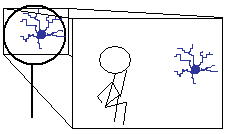
It felt roughly like this. I don't know why it looks like a tumour. Also the feeling was slightly outside my skull.

I knew I was being conditioned because I noticed my natural reactions getting changed. (Sadly, I forget which reactions.) I knew it was due to highly impressionable psycho-social development because the feeling of being conditioned was very similar to the feeling of thinking about dealing with the other students.

I still wanted good grades (foolishly) but rather objected to being conditioned.

So I willed it to stop. I recalled the feeling of the network, and added the idea of eye contact to get it to sit up and pay attention. I imagined myself telling it to shut down. It did. 

Once I escaped school, I needed to get it to wake up again. 


I repeated the recall image and then nudged it awake. 


It turns out you can in fact delay developmental benchmarks if you want. The downside is you need to know, as a stupid kid, which benchmarks to play around with. I got lucky with this one, I broke some things playing around with this.

Wednesday, July 24, 2013

Big Bang is Unphysical

I've worked out how to articulate the problem with the Big Bang theory.
"Extrapolation of the expansion of the Universe backwards in time using general relativity yields an infinite density and temperature at a finite time in the past."
Works out fine working backwards. It's not-infinite in the moment before it gets infinite, and being compressed. Well, works out enough, I suppose.

The problem is going forward. How does the infinite state know it is supposed to become not-infinite? How does it run out of energy? The past doesn't know the future. Mathematically, infinities can't know how big they are. Technically speaking, math never deals with infinities per se, but with limits. Problem is, an infinite physical state can't use l'Hopital's rule on itself. It doesn't know what function it is the limit of. Which means it's not the limit of a function, but a real, honest-to-goodness infinity.

Or, put another way, when your model assumes the infinity is the limit of some function, I can counter with an identical particle that's the limit of some other function, which is the classic test of 'undefined' in mathematics.

Which means it can't run out. An infinite state should stay infinite forever.

Or, it is strictly speaking undefined.


I should stress I have no real issue with the Bang in general terms. However, specificity is critical to physics. Fixing this infinite is likely to have wide-ranging consequences, not at all subtle.


Hopefully a theme is becoming clear: physicists do not think about their theories anymore, and it is causing serious issues. They do the math, trust they've done the right math, and haven't.

Wednesday, July 3, 2013

Progressivism Diagnostically

This post is subject to updating.
July 5: bit about the host's flaws constraining the rulers.


Progressivism is an atheistic religious cult bent on political domination for the purposes of parasitically living off the host culture.

I'm about the call the host culture shallow, easily manipulated, and gullible towards even mediocre authority. Possibly I'll also reference that its historical literacy is negative, that curiosity is slightly frowned on, and that two of the most respected kinds of jobs are politicians and actors - both of which have 'excellent liar' on the want ad.


Progressivism uses lies/bullshit and social pressure to spread behaviours that uphold progressive power structures. As a result, while Progressivism is historically rooted, proximally all of its professed beliefs are those which support its own power.

For example, Progressivism thought of vegetarianism because it is a child of Puritan Protestantism, which hates the idea that anyone might be enjoying themselves, because they're sure not. But, it amplified/bandwagoned and upheld vegetarianism because meat is warrior food. Meat promotes honour, independence, and self-reliance by supporting the underlying endocrinology. As another example, Progressive's atheism most likely stems from the injunction about separating church and state. Much easier to pretend not to be a church if nobody goes to church, rather than trying to reverse the injunction. 

Progressivism exploits the limited inferential distance of the layhuman. For example, it supports lies by opposing it to a more obvious lie.

Creationism. The Progressive take on evolution would be autoaphyxiating if they seriously believed it. However, it is portrayed as the alternative to creationism. Creationism seems obviously crazy; Progressive evolution, only crazy once you think one or two implications down the road.

Progressivism uses emotional vulnerabilities. Using rhetoric, sympathy is spun into power. Using rhetoric, power anoints the sympathetic. The ruler who rules for the downtrodden is considered legitimate. Even if the downtrodden are made worse off, as is the case.

The poor were once a useful club to beat various groups with. Now they're not, so their sympathy status was revoked and given to somebody else. 

Women were not historically oppressed. Women had a set of imposed obligations that matched the obligations men had to care for them. However, "That's mean to girls!" is a highly sympathetic statement, and so now women are so privileged in divorce court that no man would marry one unless they absolutely have to. (I exaggerate. Slightly.) 

See also: China aborting girls. Because pensioners are legally obliged to support their unmarried daughters, whereas sons are legally obliged to support their parents. Attempting to privilege women falls afoul of market effects and game theory.

It doesn't matter whether 'for the downtrodden' is a good idea or even possible. It doesn't matter who in fact deserves sympathy.

For the layhuman, that they feel sympathy is strong evidence that sympathy is deserved. Having to admit a mistake is much worse than sympathetically supporting or sacrificing to someone undeserving.

Progressivism has successfully appointed itself arbiter of evidence. Any fact contrary to its pathetic rhetoric can be suppressed by fiat.

It is not only by inspection that we know that men are different from women, we know it scientifically. (Via.) This paper will of course never be mentioned in any American Empire newspaper, and I highly advise you to not bring it up at the watercooler. If it does somehow get a public showing, it will be denounced as crimethink, and a combination of loyalty and fear will immediately send it to the memory hole. 

Tragically for science, what these differences mean, in terms of face-to-face and lifelong outcomes, will not be investigated. Presumably some male-female difference is cultural and thus up for debate and experimentation. How much? Which ones? Wouldn't it be cool to be able to choose from an array of archetypes to try to live up to? 


Many progressives live only for Moldbug's 'impact.' The point of gay marriage isn't marriage, much less gays. The point is to pick a fight and then win it, because that's fun.

Welfare makes the poor poorer. Do you think the blacks in Detroit have profited by the measures used to ethnically cleanse the city of whites? If you do, isn't it kind of racist to say they would be even worse off if the state hadn't sided with them? 

Progressivism jealously despises all other forms of power and influence.

Is Progressivism Marxist? No, in its opposition to e.g. the family, Marxism is Progressive, and thus progressives adopted it. Are Progressives Keynesian? No, Keynesianism justifies the economic fuckery the progressive was doing anyway, and so it was adopted by Progressives. Is Progressivism equalist? No, Progressivism grew up in democracy and in the minds of demagogues. The people by and large are consumed by envy, and thus envy leads to sympathetic arguments for 'equality' and thus equality is Progressive.

The paradigm progressive fears losing power above all else, irrationally. The peasant progressive's primal fear is a variant, about being in the wrong mob.

As true children of Puritanism, proggies have difficulty genuinely enjoying things. It is also obvious that enjoying yourself isn't that hard - if nothing else, children do it all the time. No training. This results in a persecution complex, which results in a desperate desire for power, to defeat the persecutors. Power is rewarding in a crocodile sort of sense, which reinforces this vicious cycle. 

Like any social group, Progressives must keep outsiders on the outside. Since equality and inclusivity are explicit premises, they must do so covertly.

One primary mechanism is by selecting for tolerance to cognitive dissonance. The more contradictory ideas you can hold at once without aggravation or having them kill each other, the more Progressive status you can attain. This is especially important for hypocrisy, such as maintaining the exclusivity. These beliefs are euphemized as 'counter-intuitive' and the trait of believing them to the exclusion of progressive-condemned beliefs as 'open-mindedness.' Openness is a genetic personality trait.

This also helps with playing no true Scotsman. Since Progressivism is self-contradictory by design, almost anyone who does not uphold their power directive can be cast out by using one horn of the dilemma or the other.

That the host culture is shallow, easily manipulated, and gullible toward even mediocre authority puts some constraints on what the ruling elite can be like. Any elite that does not exploit these flaws for power will likely lose in competition for power. Those with the personality and ideology to fully exploit these flaws will end up looking a lot like Progressives.


This unfortunately means that even taking away the demotist power and legitimacy structure would not likely create much social change. It might temper the worst excesses.

My pet example being my own pet ideal - property rights uber alles.

It would make it impossible for progressives to pay off their allies by coercing payments from enemies. However, they could exploit the gullibility vector to make the payments voluntary. The shallowness would prevent many of the victims from realizing they're victims, and thus they won't even resist.

Freedom of association would become absolute. Quotas would then come from progressives exploiting their appearance of moral authority to exhort the willing, consenting inhabitants to follow quotas. 

CEOs would be ruthlessly selected for leadership competence, instead of selected for obedience to progressives. The progressive candidate would still win, since the employees they're leading would still be gullible, easily manipulated, and shallow. 


Of relevance, conspecific parasitism. It's unstable because host can convert to parasite, simultaneously increasing parasite load and reducing the supply of hosts, thus making the marginal host more likely to convert, twice over.

Early feudal lords seemed to realize this and slowed the process by legally demarcking classes. However, their sons had downward mobility, creating a darwinian incentive to abolish or mitigate the system. Simultaneously, the merchant classes were not nobles, and the nobles became poor. Stick, carrot.

Thursday, May 30, 2013

Summary of Libertarian Versus Anarcho-Capitalist Theory and Predictions

I probably seem more certain than I am. I've probably forgotten something important.


In short, if you understand standard economics, you are a libertarian. Comparative advantage, immigration as bonus human capital, the inefficiency of government intervention in all spheres of life, particularly drugs and charity. Libertarians believe that what is economically best is best simpliciter.


An anarcho-capitalist is a radical  economist, usually Austrian, who also holds the moral position that coercion is always bad. You can often see this phrased as 'the NAP,' the non-aggression principle.


(I will mainly be avoiding the cultural aspects. For example, most libertarians like gun ownership to the point they're suspicious of non-gun owners. (I don't own a gun, just a bow.) It seems that standard economics broadly supports freedom, and therefore libertarianism attracts the freedom-loving. Most libertarians think freedom is the highest virtue. None of these position are necessary or entailed. Occasionally the positions makes them ignore their own theory.

Anarcho-capitalists are frequently extremely cantankerous toward authority, and while this improves free thought, it causes disagreements for the sake of rejecting any particular ancap as an authority on ancap. I will be shamelessly promoting my own version. For example, I believe this cantankerousness allows ancaps to see the many flaws in standard economics, not only in being not-Austrian but also in its many bits and pieces of state-worship. Get paid by the state, be unduly sympathetic to the state.)


---


The libertarian believes that the state - defined here as the monopoly on legitimate coercion - is either unavoidable or that a certain amount of strictly limited coercion is necessary for a healthy economy.  Libertarians vary between hard minarchism to moderate minarchism. Between the night-watchman state and that plus rules against driving without a license and burning soft coal for heat. (See comments by the author.) Libertarians believe that the law is inherently coercive, inherently necessary, but that this coercion can be safely bottled up with objective rules, at least as long as the populace is moderately vigilant. For example, as long as there's a free press which seeks out abuses of power and reports them to their subscribers.

Libertarians, living in democratic times, believe that which laws the night-watchman state should enforce should be decided by popular vote.


Libertarians justify identifying the economy with human flourishing. Free humans work towards their own personal gain, which they are capable of achieving. However, other humans are roughly as competent, which means direct competition is costly; instead, humans naturally cooperate, resulting in exchange of value for value, making everyone richer. When value is exchanged, it is proof that humans are successfully working towards fulfilling their own values, and this can be measured, if crudely, by things like GDP.

For a different way of seeing this, a strong economy absent government favouritism makes everyone richer; richer people are more capable and powerful, and thus able to satisfy their values.

Free is defined as not interfered with by the state. Religion is a distant second, but in some times and places, religion can harness coercion much like the state and thus interfere with the exchange of value for value.

Standard economics proves that you cannot tax capital, or equivalently that progressive taxes are highly distorting, which means wasteful and counter-productive. The state should be funded by a flat income tax. In any case, taxes are way, way too high.

Some libertarian predictions:

Free trade is always to the benefit of both parties, or otherwise they would stop trading.
Immigration provides more labour, which means more wealth. It is best seen as free trade in labour - someone at home has to be willing to hire the guy to make it worth the move.
Arming and training average Joes would decrease crime, decrease the need for police, and even decrease death by guns.
Taking drugs may be a poor choice for some people, but it is their mistake to make. The state attempting to stop them is horrendously violent and destructive, and mostly futile in any case. Legalizing drug use has been documented at least once to reduce drug use. Despite price decreases. Revoking the USDA food pyramid and generally getting out of food-nanny Dodge would similarly increase public health.

Libertarians predict that the economy would rocket if economics was taken seriously.  Here's (same as coal-link above) a moderately complete list of policies that should be rolled back. (Ctrl-f "ordinary Europeans" to skip the preamble.)
Lack of government intervention includes fiat money. Libertarians usually favour gold, but bitcoin works, indeed any currency that doesn't inherently depend on coercion.


---


Anarcho-capitalists reject even the night-watchman state on several grounds.


While libertarians are sympathetic to public-choice theory, ancaps aggressively embrace and extend it. Public choice theory indicts all forms of government. It makes the tyranny of the majority seem like a mild pathology, barely a hiccup. There is no market failure so horrible that it won't inevitably be made worse by government intervention.

For example, the conversion of a democracy to a permanent bureaucracy is inevitable. Facing either term limits or an uncertain election in the future, the elected politician works toward legislation to create a sinecure for their buddies, who will then hire them after their term. This is hardly difficult, as their fellow elects feel the same way. Similarly, since state agents are selfish, they will try to arrogate all benefits to themselves. Since by definition of 'state' they have the power to do so, they will succeed. There is literally no point in having a government except to enrich government. Almost every case looks like the government creating the healthcare crisis it now wants to pretend to solve. Even if legislation manages to ban soft coal, coal was already going out of style. Legislation is a trailing indicator of good behaviour, and a leading indicator of only harmful behaviour.


I'll also mention the various historical records of social order achieved through voluntary, bottom-up processes, showing that the state is unnecessary. I can point to Iceland, Somalia (outside Mogadishu), a place in upland southeast Asia called Zomia, and I've forgotten one or two others.

However, strictly speaking, anarcho-capitalism is the ur-government, under which almost any social order can be constructed...presuming you can convince the subjects to sign on the dotted line.

There's currently one now, the Amish, who are 100% full-test anarchs by my theory.
"The ordnung is only accepted by, and binding on, members of the congregation when, as adults, they are baptized. [...] Prior to the ceremony, ministers offer the young adult the opportunity to back out, telling him that “it is better not to make a vow than to make a vow and later break it . . . .” [...] A bishop whose interpretation of his congregation’s ordnungen is at odds with what the members want is not subject to impeachment or a recall election, but he is at risk of finding himself with no membership."


It is taken as axiomatic that all coercion - defined here as one human imposing their values on another - is bad. As can be seen by the definition, for coercion to occur, one human must smother another's values, inherently reducing the total value of the world. I will note, but defer the proof, that this definition also justifies self-defence, such that self-defence against an attempted value imposition is not itself coercion. (Basically, defeating evil can't be evil.)

The anarchists' rejection of coercion has some surprising consequences. Did you know free trade, including free trade in labour, is illegitimate? It is the government deciding for you whether you want immigration or not. When two trade, either I'm one of them and it it's none of your business, or I'm not one of them and it's none of mine. Using the Amish model, it is none of my business what another congregation's Bishop says about immigration or trade.

Similarly, 'freeing' the slaves. The slaves were not given the choice to stay on the plantation. Perhaps none would have wanted to, but the abolitionists did not ask, they simply imposed their values on another thede.

Part of ancap's rejection of personal authority includes rejection of standard economics. When it says comparative advantage, ancaps say, so what? The market knows better than you. Better than any of us. If what you say is true, then the market will agree with you. If not, then the market will kick your ass. If the Bishop says immigration is bad, and it is, then the market will reward the congregation that bans it. Part of how you know coercion is bad is because it is unnecessary.

Naturally, ancaps are very suspicious whenever standard economics shows the state did anything good. (I've yet to find a case where the suspicion was not justified.) So-called 'public' goods are either mismanaged regardless or only seem public through sophistry and ignorance.


Due to the inherent moral position against coercion, anarcho-capitalists believe the police and army should be privatized. (Please note, not abolished.) There is disagreement about what, exactly, this would look like, and I'll be selfishly talking up my own position. Essentially, law needs to be opt-in, with the option of attempting to provide your own security. This allows individual variation on laws, which allows noise, which means experimentation and natural selection.


Anarchy is hands-off in defining human flourishing. If a truly free society does not want to grow economically, it does not have to. (The Amish grow in population but are decidedly slow in buying power.) Though, it is considered likely. Humans want to empower themselves, and when this comes through techniques and technology, it means economic growth. If nobody is being coerced, then by definition values are getting maximized.

An anarchist individual may hold any religion they want, but are subject to self-defence if it wants to impose itself on anyone else. Beliefs are property too.


Taxes, defined as coercive payments, are illegitimate. If you can't sell your service, then you don't deserve to be paid for it.


Anarchist predictions:

Violent revolutions are bad. Historical revolutions never stop their violence at self-defence. Second, while top-down order is bad, that doesn't mean disorder is good. {I like to say chaos = delta(power)} The market can only respond so fast to changes. When governments fall, they change too fast, and people die even if nobody is being beheaded on camera.

Voting, as inherently coercive, can never result in a free society.

As long as immigrants and the sponsors of immigrants are held accountable and responsible for the effects, the market will reach a healthy, pro-social level of immigration.

Being the ur-government, anarchy can accomodate fiat money. It's between you, your bank, and your trading partners; none of my business. However, fiat money probably can't survive without coercive backing, because its whole reason for existence is inflation. If businesses can refuse paper, they usually will, and we would likely return to a historical bank note situation, with added cryptographic assurances.

How you use drugs is none of my business. It is between you and your security provider.

Whether you should be allowed a gun is between you and your security provider. Will they have to pay more damages to you if you have no gun, or to others you use the gun on incorrectly? They would know a lot more about that than I ever will. Similarly, if a bar requires you to disarm before entering, they take responsibility for your safety.

The market is made of people. Any solution government can think up, the market can also think up, except it isn't allowed to force you to pay for it.
One way for private law to work is by trying crimes to acts on individuals. If you leave someone alone, they cannot charge you with anything. However, if you interact with them, you must implicitly or explicitly agree not to interact in certain ways they would rather you didn't, on pain of dealing with their security provider. In return, they agree to not do certain things to you.
Many anarchists want criminal penalties to stop at shaming. I think it should be formal and contractual. Then, the penalties are definitively not coercive - you have agreed to them, and applying them is simply holding you to your word.
As for sudden violent assault, then you never agreed not to defend yourself. Equivalently, almost everyone values seeing the sudden assailant defeated.
In practice, we would have laws and courts almost exactly as we have now, perhaps even professional police, but the laws others would be held to when dealing with you would be decided by you, not by the court. The market would reward courts that defended their clients well, not those with 40 000 laws on the books. If for no other reason than it would be too expensive to try to trade with them.

It may turn out that the honour and reputation system for contracts is superior to violent tort enforcement. Someone will try it, and we'll find out.

Wednesday, May 8, 2013

Juxtaposition VIII: Wholeheartedness

Touching the Raw Amygdala, Part II:
"I assume this is because the Narcissist desperately wants to be able to assert the inferiority of another, and the superiority of themselves by comparison. [...]  The word contempt carries a subconscious air of their K-type adversary’s superiority, and the Liberal’s inferiority. Although minor, such aspects of language have profound effect upon Narcissists and Liberals. Always denigrate the Liberal’s importance and power within the social environment, and never imply they are important enough to warrant a real emotion."
Anatomy of a Hater:
"That’s the archetypal hater: a lifelong fuckup. A thirtysomething lawyergrrl with the personality of a sea slug and a burning case of baby rabies. A castrated cubicle worker in thrall to his Michelin Man-sized wife. A sick woman who gets a double mastectomy because she thinks she’s a man trapped in a woman’s body. A 300-pound momma’s boy playing video games in his parents’ basement."
Brené Brown on connection, (via) somewhat paraphrased:
"I want to separate courage and bravery for you. [...] It's from the latin word cor, meaning heart...the original definition was to tell the story of who you are with your whole heart. [...] They fully embraced vulnerability. They don't talk about vulnerability being comfortable, nor excruciating." (Paraphrased because exact words would take me several times longer.)


Don't forget juxtaposition V: reality vs. presentation. Who is the main character? The nominal subject, or the author?

Friday, April 12, 2013

Perpetual Motion by Means of Black Holes and Dark Energy

I can tell that physicists don't understand black holes or spatial expansion because the current models can straightforwardly make perpetual motion machines.


First, get some unobtainium. A string with a tensile strength a few million times any known material should be sufficient. Wind the unobtainium around a spool, gear the spool onto a turbine, and lower one end into a black hole. From our perspective, the string has infinite space to fall into before it hits the event horizon, so the string can be fed into the hole indefinitely. The only difficulty is manufacturing the string for less than the turbine creates in power, but the force, and therefore the turbine output, is inversely proportional to the size of the black hole in question. The Schwarzschild radius decreases linearly with mass, but force increases as the square. A half mass size black hole pulls half as hard at a given distance, but is also half radius, which means it pulls twice as strongly at the event horizon.

Two bits of luck at this point. First, it is unobtainium, so I can make it as thin or as strong as necessary. Second, a suitably small black hole may evaporate quickly, but the string would, according to convention, replenish the black hole. (Even though we never see it reach the black hole.) Simply increase the force (and tensile strength) and lower the feeding speed until the turbine makes more energy than you're putting in.

There's also a reaction force to take into account, so these need to be built in pairs. Solid rings aren't orbitally stable, so I need slightly bigger turbines to power the stabilizing thrusters.

(For lulz, search up black hole perpetual motion and be amazed at how complicated they try to make it.)


The second method may need much stronger string, and costs much more to set up, but I don't have to worry about feeding the string slower than the black hole evaporates.

The velocity of other galaxies is not a normal kind of velocity. We see Doppler-shifted light because the space the wave is in expands while it is travelling through it; it just happens to work out to be exactly how much it would be redshifted by real velocity. Acceleration is absolute, because it usually requires transfers of energy and thus interactions and mass flows. Other galaxies are accelerating but not gaining kinetic energy, because otherwise we would be gaining kinetic energy. (Or I could say their velocity is changing without acceleration.) Nevertheless...

Tie the unobtainium around a couple rocks a few million light years away in opposite directions. They will accelerate away indefinitely, powering the spool turbines. Indeed, the output will increase the longer the machine is run. Though the friction losses alone will be immense, and the tension at the rock's end will grow faster, so it needs especially pure unobtainium.


Perpetual motion machines are singularities. If nothing else, potential energy has mass too, and so they should have infinite mass and subsequently destroy the universe.

You can try to argue that since these need unobtainium, they aren't naked singularities. In any realistic situation, limits of electromagnetic bonding and so on, the strings on the expansion machine will snap before they break even. Galaxies accelerate away from each other, and so won't ever turn this phantom kinetic energy into a collision. The black hole small enough to create more energy than it consumes in mass will evaporate so hot it burns the string to plasma.

However, the second law of thermodynamics is supposed to be true even in highly idealized mechanisms. A frictionless Carnot engine with zero switching costs between its infinite hot reservoir and infinite cold reservoir still cannot break even. All I need is a very strong kind of string. I could also use a ridiculously sized bit of piezoelectric.

To be precise, a Carnot engine feeding into absolute zero can be 100% efficient. However, my unobtainium spools can produce infinite energy for zero cost by turning an infinitely large turbine infinitely slowly with an infinitesimal string. This means if you back off from those infinities, you can get any amount of energy you might need.

Put another way, it is not feasible to make these machines profitable for humans, but if I did this with regular twine, while it break almost immediately, for that fraction of a second more energy would be coming out of the system than went into it, even though I wouldn't be able to capture most of it. If I can do it, nature is doing it, it is merely a question of when and where.

If something seems to be violating conservation of energy, it isn't, you've overlooked something. These models have overlooked something apparently infinite.


I find that physicists often, usually, forget that they don't understand black holes. Or space in general, it would seem - "shut up and compute" has laid low most of the field. To be charitable, do I assume they talk about it at physicist cocktail parties, just never in public? Not even during lectures?

Sunday, April 7, 2013

Other Minds and Colour Qualia

Yes, there are other minds, and they see the same colours as yours.


There's a trick from physics. If an electron can't apparently know where itself is, but every other particle knows where it is, then the electron must know where it is, even if we can't figure out how. It works because the next position of the electron must be consistent with the observations of all observers, and to reach there, the electron had to have been in the observed location.

By yourself, the other-minds problem is apparently insoluble. However, the problem would only occur in the first place to a conscious entity, as there is no observable explanandum for unconscious observers. (Go on, start listing things that you haven't thought to explain because they don't exist.)

As per my last post, objective entities cannot properly pretend to be conscious. An unconscious entity can only parrot the words of the other-minds problem. (Wikipedia isn't conscious, but you can read it there.) Which means when you observe a statement of the other-minds problem, you can be certain there's a mind in the statement's past light cone. Combined with your certainty you have a mind, you can be certain there are other minds.

Relative to that other mind, you might be parroting, like Wikipedia. However, literally all other conscious observers can be certain there are other minds. When a fact is knowable from all perspectives but one, it is knowable from all perspectives. Even if you can't work out how.

If nothing else, I can back off slightly from pure idealism and note that it must have been independently stated as a problem by at least one other person.


I'm pretty sure but can't quite prove that conscious entities are absolute. If red is unmistakable, then when you think you see red, there's only one possible entity you can be seeing, red itself. (Plato was almost right.) Similarly, for the brain to talk to consciousness, it would either have to tune the signals after each birth (and tune it to a standard according to what? How would the standard know to be different?) or the signals are themselves absolute, so they evolve once and stay good.

Regardless, there's an entirely separate line of evidence that they're absolute, at least inside each mind. Conscious entities can be similar or different from each other, just like objective entities. Blue is similar to cold, and red is similar to warm. (Sharp sounds are similar to sharp surfaces, and smooth sounds are similar to smooth surfaces.)

We know from other complex phenomena that simply inverting them cannot preserve all symmetries. The opposite of red isn't blue, it's cyan. Cyan is similar to energetic and blue is similar to calm - they are similar to each other in some ways but different in others, which means even if you also inverted calm and active, the colour characteristics would no longer hold. The red-warm-energetic relationship converts to cyan-warm-energetic - that fire still looks as warm and frenetic as it feels - but cyan was originally energetic, it should register as calm on the inverted scale. If you don't invert that scale, blue-cold-calm can't convert to yellow-cold-calm, because yellow isn't calm - someone who saw this way wouldn't find ocean waves soothing, because of the colour.

Meanwhile, warm and cold are direct opposites, but the sensations indicating such are not. Especially hot, which is qualitatively different from warm, as reflected by the fact that hot results from the warm and cold detecting nerves being excited simultaneously. You cannot change the relationships to make red similar to cold without changing the relationship between cold and warm and hot, thus changing the second-order relationship between the red-blue relationship and the cold-warm relationship.

A person with an inverted or rearranged colour scale would have different relations of similarities between their sensations, no matter how cleverly rearranged. Since we do not observe different relations or relations-between-relations, we can safely conclude humans see the same colours the same way.