This post is subject to editing. Hopefully for clarity. Or I may simply merge it with part 2.
--
The fun part is it can be built with current technology. The sad part is I have no idea which order to explain the thing in.
This is it:
Take an FPGA and hook it up to a true-random source like a collapsing superposition. The FPGA's input is the bitstream representation of the random source. It then processes it and outputs a transformed bitstream. This bitstream is fed into the FPGA's configuration register, re-programming itself, and then used to bias the true-random source for the next cycle.
(Caveat: ideally the FPGA would have infinite gates so it can produce infinitely long unique bitstreams. I have a counter you don't care about.)
So how does this work? Double recursed probabalistic input, technologically violating the independence clause of the probability laws.
What is the probability this machine will put out any particular bitstream? Say, 10000101000101? If it's this cycle, it's simply the probability the true-random source will choose that. If it has five output states, it will be 20% or so depending on biasing. If it can only get to 10000101000101 on the next cycle, it's 20% squared, 4%. Because it's randomly re-programming itself, it can reach any bitstream. (Given a good choice of interpreter/code for the configuration register.) The probability of it being in any particular state drops very quickly with time, and is entirely path dependent.
It's all path dependent, but the device cannot know how much path it has already traversed, and since it reaches undefined probability in the future, it has undefined probability right now.
It's a machine with no defined probability at a finite point in the future, because it has too many states to each get a quantum of probability. If you won't buy quantized probability, then at t=0 infinity it has infinite possible states of each infinitesimal probability, and infinitesimal is physically identical to zero.
Since time is relative, the machine cannot tell how far down the probability tree it is; the undefined-probability future must be exactly the same as the present, as far as it knows. It has no probability right now.
Why is it a consciousness machine? Because it's not a physical machine, and the two leftover possibilities are it's a consciousness machine or causality isn't closed. I'm betting on the former. The machine still operates, it still has an output, despite having no physical probability of having one. The causal hole is plugged by non-physics. If it were possible to access consciousness directly - by being the person in question, for example - then you could calculate the probability. But you can't, so it doesn't have one.
Moreover if the brain is indeed using a device, it makes the world less mysterious, not more. Implemented in neurons, this kind of device will consume your brain like cancer unless it is periodically reset, by for example sleep. This is due to a bias towards growing the bitstream rather than remaining stable. Since it is the consciousness machine, these resets will look like dreams. Further, neurons are perfectly designed for this kind of feedback, and the brain is immunoprivileged because there's scraps of random DNA floating around in there, possibly related to memory. Lossy DNA copying would be a perfect random source.
It's a quantum effect but warm and wet aren't a problem since it uses the collapse of superposition instead of trying to maintain it.
There's more, but I feel I've already spent too long on this.
This is Descartes' pineal gland.
What's worth saying regardless of how much I've already wasted?
This: 'perception' is when the brain sends consciousness data by biasing the true-random source. 'Decision' is when consciousness sends the brain data by choosing a formerly-thought-to-be-random outcome.
Also, the noosphere project. If the consciousness machine is real, then basically your brain is telepathic with itself, which unifies all the little quantums of consciousness.
Obviously the bog-standard silicon machinery isn't the critically conscious part. It has to be the randomness. Which means every single quantum particle is a rudimentary consciousness. An electron has no memory, it has no way to bias itself, so it's basically many of the same consciousness, but it's still conscious. (Like any good extension of knowledge, this theory reduces to the previous theory given certain limits.)
When is telepathy allowed? Can it leak? Probably, it can leak. And if it does, it would look exactly like what the noosphere project is measuring. It will leak when many people are paying attention to the same thing, causing reinforcing interference.
The function of the pineal gland circuitry, then, is consciousness amplification. And it doesn't have to be hooked up directly by wire to the random source, any form of information transfer will do. But perhaps weaker transfers result in weaker telepathy and thus weaker amplification. Unless many minds are all amplifying at the same time in the same way.
--
There is a problem, in that I don't yet know what the output is supposed to look like. If it's like the noosphere project, it will be easy. Despite having no well-defined probability, you can still compute a local probability. The machine will flagrantly ignore that. It will repeatedly choose a single path or a similar path, ignoring others.
But the machines aren't directly comparable, because present decisions are a function of all past decisions. The path space is huge. It would take an immense number of trials to see any kind of small bias. Especially if it's small, or if the machine takes some cycles to 'wake up.' (Phrencellulate, for when you feel pretentious.)
Moreover, since the machine has no probability, the mere fact that it doesn't destroy the universe may constitute evidence that it's working as I describe. If we accept that quantum bits are conscious, then having a low probability of your next action is just what high consciousness looks like from the outside.
Friday, May 16, 2014

Sunday, May 4, 2014
AutoEngineering - Psychological Needs
Psychological needs don't real. Rather, personality features have maintenance costs. One of the dangers to the novice autoEngineer is noticing the expense of a needs and disabling it. There's no warning about the associated personality feature that will also be disabled. Learning can be expensive, as rebuilding personality features is difficult and sometimes impossible. However, once aware of the issue, it's easy to check because the need and the feature share a tag. They have a feeling in common. Epistemically, it's also easy to check, because disabling a personality feature likewise automatically disables the associated maintenance.
One possible exception: I recall seeing a warning on a particularly universal feature, but I can't remember what it was or even invent an example.
From a software perspective, psychological needs are exactly like physiological needs. If you disable eating, you disable life. If you disable life, you disable eating. However, physiological needs have warnings.
One possible exception: I recall seeing a warning on a particularly universal feature, but I can't remember what it was or even invent an example.
From a software perspective, psychological needs are exactly like physiological needs. If you disable eating, you disable life. If you disable life, you disable eating. However, physiological needs have warnings.
Sunday, March 9, 2014
Evidence and the Reasoning Subconscious
I began to suspect that nobody, even me, respects evidence. In particular, not Less Wrong nor reactionaries. On reflection, I'm equivocating on 'evidence.' (Or: Aumann's theorem will never obtain.)
First, the sample bias. I can only consider those who write about their beliefs. Perhaps many are convinced by evidence, but would never blog about it, indicating a strong negative correlation.
Second, my counterfactual: there should be heretic neoreactionaries. Someone who buys say HBD but also AGW, because, coincidentally, they've seen a particular subset of evidence for AGW. Similarly, it should be possible to change a NRx's mind, and back again, by using subsets of evidence. We're always using subsets of the evidence, the question is whether it is a representative subset, so it should be possible to see-saw someone's mind by defrauding them with non-representative subsets. This fraud should sometimes happen by ignorance or luck.
Or: too much tribal correlation. Humans make mistakes, and they should occur in a random direction.
On Less Wrong the evidence is less clear, which brings me to the point about evidence.
Third: my equivocation.
There's scientific / natural philosophical evidence. There's also evidence that is difficult to describe, explain, or pass along.
The latter kind dominates subconscious processing.
The subconscious functions much like a machine language layer, which the consciousness communicates to in a very high-level language. It is labour intensive to consciously think. (But, e.g. necessary when learning math. Passing add(2, 5) to the uneducated subconscious returns [?].) It's easy to pass think(apples, red) to the subconscious and get something back...but necessarily, the consciousness does not automatically understand the implementation details of think() and therefore almost can't debug it, as that literally means calling think(think(), bugs). If think() has an issue, you won't get the right answer.
(Note that to learn add() means calling think() in the right ways.)
The subconscious commands orders of magnitude more neurons than the voluntary consciousness, and it has access to the unprocessed data to use that power on. (See transcranial magnetism induced savantism.) Even after somehow gathering the implementation details of think(), it lacks a formal notation. Gathering the information means calling think() on itself. If you invent a formal notation (e.g, think()) a full account of the implementation details will presumably be orders of magnitude larger than a couple graphs and charts. Subsequently, it has to be manually checked by redundantly gathering the information it calls for (like adding by consciously counting) in case there's a typo. There will be feedback - the subconscious is watching the implementation get written and will change as a result.
At this point, I've re-derived the usual conclusion - humans can only communicate if they already agree on 99% of what they're trying to say. When think() implementations happen to match. In principle we could limit ourselves to describing the differences, but...
My think(Less Wrong, subconscious evidence dominance) returns true. Similarly, think(Less Wrong, ~see saw) and think(Less Wrong, ~tribal dissent). If your think() returns differently, I have no way of finding out why not.
Think() contradicts the notion that complex structures must be common to all individuals in a sexually reproducing species.
My prediction is that your philosophy or political leanings are almost entirely determined by which version of think() you happen to have. Once exposed to Dark Enlightenment thought, whether you buy it is determined by whether your subconscious buys it, which is determined by whether the DE article's evidence profile matches that used by your subconscious.
Charts and statistics are almost irrelevant to this process. Few think() implementations even use them, and of those that do, there's byte asymmetry. Say a conscious visual representation of a chart is worth a thousand times the bytes of its description; then, the subconscious gathered a million times as many bytes on the way to the chart.
I'm interested in knowing if it is possible to summarize what the subconscious generally uses as evidence. (How does one distinguish one article's tone from another?) If the feedback isn't fortuitously arranged, it may make it truly impossible. At least, checking a putative description is easy, as it will predict when and how minds get changed. Or not, as the case may be.
I would predict that most of what's called persuasive, isn't, but I think it is a retrodiction at this point. Most implementations of think(persuasive, argument) are bugged, which is why persuasion in general targets the wrong thing.
For now I decline to address the fact that beliefs are usually decorative, and think() is called by aliefs only.
Like a good passivist, I will hereby refrain from policy recommendations.
-
Ironically, the subconscious can return things even if not called, but does so in an even higher-level language than think() calls: emotions.
First, the sample bias. I can only consider those who write about their beliefs. Perhaps many are convinced by evidence, but would never blog about it, indicating a strong negative correlation.
Second, my counterfactual: there should be heretic neoreactionaries. Someone who buys say HBD but also AGW, because, coincidentally, they've seen a particular subset of evidence for AGW. Similarly, it should be possible to change a NRx's mind, and back again, by using subsets of evidence. We're always using subsets of the evidence, the question is whether it is a representative subset, so it should be possible to see-saw someone's mind by defrauding them with non-representative subsets. This fraud should sometimes happen by ignorance or luck.
Or: too much tribal correlation. Humans make mistakes, and they should occur in a random direction.
On Less Wrong the evidence is less clear, which brings me to the point about evidence.
Third: my equivocation.
There's scientific / natural philosophical evidence. There's also evidence that is difficult to describe, explain, or pass along.
The latter kind dominates subconscious processing.
The subconscious functions much like a machine language layer, which the consciousness communicates to in a very high-level language. It is labour intensive to consciously think. (But, e.g. necessary when learning math. Passing add(2, 5) to the uneducated subconscious returns [?].) It's easy to pass think(apples, red) to the subconscious and get something back...but necessarily, the consciousness does not automatically understand the implementation details of think() and therefore almost can't debug it, as that literally means calling think(think(), bugs). If think() has an issue, you won't get the right answer.
(Note that to learn add() means calling think() in the right ways.)
The subconscious commands orders of magnitude more neurons than the voluntary consciousness, and it has access to the unprocessed data to use that power on. (See transcranial magnetism induced savantism.) Even after somehow gathering the implementation details of think(), it lacks a formal notation. Gathering the information means calling think() on itself. If you invent a formal notation (e.g, think()) a full account of the implementation details will presumably be orders of magnitude larger than a couple graphs and charts. Subsequently, it has to be manually checked by redundantly gathering the information it calls for (like adding by consciously counting) in case there's a typo. There will be feedback - the subconscious is watching the implementation get written and will change as a result.
At this point, I've re-derived the usual conclusion - humans can only communicate if they already agree on 99% of what they're trying to say. When think() implementations happen to match. In principle we could limit ourselves to describing the differences, but...
My think(Less Wrong, subconscious evidence dominance) returns true. Similarly, think(Less Wrong, ~see saw) and think(Less Wrong, ~tribal dissent). If your think() returns differently, I have no way of finding out why not.
Think() contradicts the notion that complex structures must be common to all individuals in a sexually reproducing species.
My prediction is that your philosophy or political leanings are almost entirely determined by which version of think() you happen to have. Once exposed to Dark Enlightenment thought, whether you buy it is determined by whether your subconscious buys it, which is determined by whether the DE article's evidence profile matches that used by your subconscious.
Charts and statistics are almost irrelevant to this process. Few think() implementations even use them, and of those that do, there's byte asymmetry. Say a conscious visual representation of a chart is worth a thousand times the bytes of its description; then, the subconscious gathered a million times as many bytes on the way to the chart.
I'm interested in knowing if it is possible to summarize what the subconscious generally uses as evidence. (How does one distinguish one article's tone from another?) If the feedback isn't fortuitously arranged, it may make it truly impossible. At least, checking a putative description is easy, as it will predict when and how minds get changed. Or not, as the case may be.
I would predict that most of what's called persuasive, isn't, but I think it is a retrodiction at this point. Most implementations of think(persuasive, argument) are bugged, which is why persuasion in general targets the wrong thing.
For now I decline to address the fact that beliefs are usually decorative, and think() is called by aliefs only.
Like a good passivist, I will hereby refrain from policy recommendations.
-
Ironically, the subconscious can return things even if not called, but does so in an even higher-level language than think() calls: emotions.
Friday, March 7, 2014
ARFAQ Spot Check: Suicide
Nick Land provides the 1928 suicide rate among kids, almost by accident.
A quick google gets me 2006.
Unfortunately the numbers aren't directly comparable. But, some quick estimates from the available data.
10-14: < 0.5 to ~1.5 per 100k
15-19: ~4 to 7 per 100k.
Slightly more dudes than chicks in this cohort used to kill themselves. Now, it's twice as often in 10-14 and four times as often in 15-19, matching the 1928 adult ratio.
This is not 'fallen by 20%'
So, err, even worse than I thought. Once again, the graph is cut off at a very convenient time. Or perhaps magic. The stats I stumble upon first happen to support my hypothesis - Google/Nick Land can psychically know my thoughts, as well as Alexander's - and therefore the stats Alexander stumbles upon first support his hypothesis too. Very nice of magic, don't you agree? Neighbourly. I thought I would have to skip checking suicide, and then the stats fall right into my lap.
This is even discounting the fact we don't want suicides, we want suicides-that-would-have-successfully-completed-against-1928-trauma-surgeons-and-ambulances, 2006. This is even discounting the fact that we know governments fudge the hell out of their numbers.
I also noticed a double bind. Either murder rates should be going up and are being kept down by trauma advances, OR murder rates should be going down, but stagnation in trauma medicine is holding them steady. Either way, the progressive has to play god of the gaps...assuming they can even think in straight lines long enough to notice there's a problem.
I found the opening sentences of the 1928 report a huge relief. It would appear it was written by an adult. With, like, perspective and stuff. I still wouldn't call the rate large, it's just that wealth should make it go down, not up - the trend is worrying.
Well, would be worrying, were the national rate any of my business. I'm only in this for the epistemology.
A quick google gets me 2006.
Unfortunately the numbers aren't directly comparable. But, some quick estimates from the available data.
10-14: < 0.5 to ~1.5 per 100k
15-19: ~4 to 7 per 100k.
Slightly more dudes than chicks in this cohort used to kill themselves. Now, it's twice as often in 10-14 and four times as often in 15-19, matching the 1928 adult ratio.
This is not 'fallen by 20%'
So, err, even worse than I thought. Once again, the graph is cut off at a very convenient time. Or perhaps magic. The stats I stumble upon first happen to support my hypothesis - Google/Nick Land can psychically know my thoughts, as well as Alexander's - and therefore the stats Alexander stumbles upon first support his hypothesis too. Very nice of magic, don't you agree? Neighbourly. I thought I would have to skip checking suicide, and then the stats fall right into my lap.
This is even discounting the fact we don't want suicides, we want suicides-that-would-have-successfully-completed-against-1928-trauma-surgeons-and-ambulances, 2006. This is even discounting the fact that we know governments fudge the hell out of their numbers.
I also noticed a double bind. Either murder rates should be going up and are being kept down by trauma advances, OR murder rates should be going down, but stagnation in trauma medicine is holding them steady. Either way, the progressive has to play god of the gaps...assuming they can even think in straight lines long enough to notice there's a problem.
I found the opening sentences of the 1928 report a huge relief. It would appear it was written by an adult. With, like, perspective and stuff. I still wouldn't call the rate large, it's just that wealth should make it go down, not up - the trend is worrying.
Well, would be worrying, were the national rate any of my business. I'm only in this for the epistemology.
Wednesday, February 26, 2014
Note on Fascism and the Future 3
The first one was better than this one.
I'm sure the Japanese in the west would find it hard to tell the difference too.
Europeans have cultural resistance to alcoholism. For example, the taboos against drinking before noon or drinking alone. Anglo-Saxons have less enumerable resistances to democracy, having been first inoculated by its early, less virulent forms. This is perhaps the only thing that stopped us from going Auschwitz on the Japanese. Or perhaps, had the war gone the other way...
Similarly, these resistances are what stop the inherently totalitarian democracies from realizing their dreams.
-
I found his story wildly implausible. Hitler is not adaptive here, it does no good to copypasta his story. Details are good, though. In principle, someone could correct the details, but that would mean profoundly understanding Hitler. Mussolini's story is quite different in detail, but ultimately very similar. An American fascist would seem much, much different - to avoid memetic antibodies, if for no other reason. But, much as atheism is just Christianity sans book and god, an American fascist sans prison sentence, shitty book, and snazzy uniform would still be a fascist.
However, Greer has no reason not to think an American fascist might be a good thing.
"A good many of the people who liked to insist that Weimar Germany was a fascist state got to find out—in many cases, at the cost of their lives—that there really is a difference between a troubled, dysfunctional, and failing representative democracy and a totalitarian state"I'll spare you the rest of the article; no, he never justifies the link between fascism and prison camps. I fail to see how a charismatic leader or a uniformed militia imply prison camps in any way that democracy does not. I've already established that totalitarianism is hardly unique to fascism.
I'm sure the Japanese in the west would find it hard to tell the difference too.
Europeans have cultural resistance to alcoholism. For example, the taboos against drinking before noon or drinking alone. Anglo-Saxons have less enumerable resistances to democracy, having been first inoculated by its early, less virulent forms. This is perhaps the only thing that stopped us from going Auschwitz on the Japanese. Or perhaps, had the war gone the other way...
Similarly, these resistances are what stop the inherently totalitarian democracies from realizing their dreams.
-
I found his story wildly implausible. Hitler is not adaptive here, it does no good to copypasta his story. Details are good, though. In principle, someone could correct the details, but that would mean profoundly understanding Hitler. Mussolini's story is quite different in detail, but ultimately very similar. An American fascist would seem much, much different - to avoid memetic antibodies, if for no other reason. But, much as atheism is just Christianity sans book and god, an American fascist sans prison sentence, shitty book, and snazzy uniform would still be a fascist.
However, Greer has no reason not to think an American fascist might be a good thing.
Tuesday, February 25, 2014
Juxtaposition X: In Which I'm Wrong Several Times in a Row
I wanted to find that Alexander's data wasn't all buggered, but unfortunately I kept finding new reasons for cynicism.
It doesn't help that I'm bad at counting.
This kind of iterative analysis is normal for me. It's unfortunate that it seems I work best by confidently asserting a position, (it naturally causes me to question myself). Seems like it would be misleading to those I confidently state it at. On the plus side I never forget that I'm wrong all the time, due to proving myself wrong more often than right.
On issues not internal comparison; this is not an argument. I'm simply reporting my observations. I'm not saying you should trust them, but saying I shouldn't trust my own observations isn't going to fly.
First, my notes, then stats for amusements, then my final attempt at a useful summary.
Suicide: straw man - suicide vs. suicide attempts / buggered
Debt: buggered / manipulated / point in favour
Homicide: straw man - homicide vs. homicide attempts / buggered
American homicide: dubious. If true, part of worldwide, nonprogressive trend.
Worldwide anti-violence: nonprogressive, point in favour of nrx. True.
War: manipulated. Probably true?
Hours worked: true but contaminated with welfare data, so buggered for our purposes.
Literacy: worldwide nonprogressive trend, but true.
Poverty: poverty of data, you mean. Also see previous.
Hunger: point in favour of nrx, probably buggered
World per capita: true, irrelevant to nrx position, but true.
US GDP: point in favor of nrx, misinterpreted
Harvard/leftist opinion table: favour of nrx, probably buggered
Blob graph: data is buggered, values aren't 2-D.
Arrow graph: buggered, point in favour of nrx.
Political involvement: point in favour of arguments about Singapore, HDI probably buggered.
World GDP: true but irrelevant
Pop density trifecta: true, misused. Buggered by confounders.
Divorce: buggered, but even if true in favour of nrx. Premarital sex by the lady increases your risk of divorce by 15% absolute, about 1 in 6.
Divorce 2.0: not exactly news to nrx. probably true. Mostly point in favour.
US Pop growth: Straw man - nrx talks native pop growth, SSC includes immigration. Nrx doesn't know what's going on either, though. Best is here; plausible, but I can hardly blame proggies for dismissing it.
Discrimination: good news, probably true, but straw man. See Richwine etc. What the masses think doesn't matter anymore; we live in a democracy only descriptively, not in any sense prescriptively.
4: straw men.
2: graphs cut off at awkwardly convenient moments.
8: data actually favours nrx predictions.
16: data interpreted overgenerously for progressivism.
10: data most likely true.
12: data is untrustworthy.
Total: 22
By descending seriousness of error:
12: probably untrue or self-contradictory.
2: straw men.
1: time range manipulated or chosen for convenience.
4: easily interpreted to favour nrx predictions.
3: irrelevant.
Unfortunately, that's all of them. None of the graphs are evidence neoreactionaries need to be worried about. While it is statistically unlikely that Alexander made this many errors by chance, it is at least as unlikely that neoreactionaries are in fact correct on all these points. It shouldn't be necessary to pick such flawed data to construct a telling criticism.
This kind of iterative analysis is normal for me. It's unfortunate that it seems I work best by confidently asserting a position, (it naturally causes me to question myself). Seems like it would be misleading to those I confidently state it at. On the plus side I never forget that I'm wrong all the time, due to proving myself wrong more often than right.
On issues not internal comparison; this is not an argument. I'm simply reporting my observations. I'm not saying you should trust them, but saying I shouldn't trust my own observations isn't going to fly.
@themattsimpson There are ~22 graphs not counting redundancies, four of which I'm not very skeptical of. I guess 80% == all, for me?
— Alrenous (@Alrenous) February 25, 2014
@themattsimpson I didn't have to filter. E.g. I used Wikipedia repeatedly.
Re-did my count and got 3 of 20. I suck at counting.
— Alrenous (@Alrenous) February 25, 2014
@themattsimpson
Point against Rxn: 1
True but irrelevant: 4
True but misinterprted: 4
Untrustworthy, manipulated, point in favour of Rxn: 11
— Alrenous (@Alrenous) February 25, 2014
First, my notes, then stats for amusements, then my final attempt at a useful summary.
Suicide: straw man - suicide vs. suicide attempts / buggered
Debt: buggered / manipulated / point in favour
Homicide: straw man - homicide vs. homicide attempts / buggered
American homicide: dubious. If true, part of worldwide, nonprogressive trend.
Worldwide anti-violence: nonprogressive, point in favour of nrx. True.
War: manipulated. Probably true?
Hours worked: true but contaminated with welfare data, so buggered for our purposes.
Literacy: worldwide nonprogressive trend, but true.
Poverty: poverty of data, you mean. Also see previous.
Hunger: point in favour of nrx, probably buggered
World per capita: true, irrelevant to nrx position, but true.
US GDP: point in favor of nrx, misinterpreted
Harvard/leftist opinion table: favour of nrx, probably buggered
Blob graph: data is buggered, values aren't 2-D.
Arrow graph: buggered, point in favour of nrx.
Political involvement: point in favour of arguments about Singapore, HDI probably buggered.
World GDP: true but irrelevant
Pop density trifecta: true, misused. Buggered by confounders.
Divorce: buggered, but even if true in favour of nrx. Premarital sex by the lady increases your risk of divorce by 15% absolute, about 1 in 6.
Divorce 2.0: not exactly news to nrx. probably true. Mostly point in favour.
US Pop growth: Straw man - nrx talks native pop growth, SSC includes immigration. Nrx doesn't know what's going on either, though. Best is here; plausible, but I can hardly blame proggies for dismissing it.
Discrimination: good news, probably true, but straw man. See Richwine etc. What the masses think doesn't matter anymore; we live in a democracy only descriptively, not in any sense prescriptively.
4: straw men.
2: graphs cut off at awkwardly convenient moments.
8: data actually favours nrx predictions.
16: data interpreted overgenerously for progressivism.
10: data most likely true.
12: data is untrustworthy.
Total: 22
By descending seriousness of error:
12: probably untrue or self-contradictory.
2: straw men.
1: time range manipulated or chosen for convenience.
4: easily interpreted to favour nrx predictions.
3: irrelevant.
Unfortunately, that's all of them. None of the graphs are evidence neoreactionaries need to be worried about. While it is statistically unlikely that Alexander made this many errors by chance, it is at least as unlikely that neoreactionaries are in fact correct on all these points. It shouldn't be necessary to pick such flawed data to construct a telling criticism.
Monday, February 24, 2014
Anti-Reaction FAQ Spot Check and Epistemic Principles
Matt Simpson can say things I can't predict.
So I felt this was worth checking up on.
The suicide rate is full of confounders, so I skipped that one. See also Nassim Taleb about measuring distributions by sampling their extremes. (What we want to measure is happiness or satisfaction, not suicide per se.)
For a start, 2008 is an awfully convenient end point.
Simpson had this cogent rebuttal:
However, it also supports the hypothesis that government debt has an equilibrium level. It used to be around a fairly sensible 35%, but has been steadily increasing since 1981.
Thus far, the data is not conclusive in either direction.
I hope Alexander didn't look at post-2008 data. Hopefully you can safely trust that I didn't look at post-2009 data before the above logic.
United States gross debt passed 100% in 2012 and currently stands at 106%. If you knew Reagan had a military buildup and knew nothing of the present but the debt graph, you would think America was at war.
Conclusion: Alexander is not predictive. Reaction is predictive.
To check my work: the IMF itself, the source of half these numbers, thinks public debt is on the reactionary trajectory.
Edit:
Can't agree. Baseline goes up. Still looks like America's starting a war.
I don't think Alexander is intentionally cherry picking his data. I think he has some epistemic diseases.
First, I don't actually trust any of these numbers.
For comparison I looked up Canada's debt and found that everyone is lying about it, and I have no idea how the IMF calculated its numbers. It is not science: it is not verifiable.
The US numbers aren't verifiable either. They're probably being cooked or massaged down the way Financial Post massaged the number up. No disinterested observer would conclude the US government is really only a third of the economy, for example. Add in NGOs and regulatory costs borne by the private sector. Add in decisions 50% controlled by regulation at 50% government action. That's just off the cuff.
Alexander trusts the numbers.
Second, Alexander thinks that numbers can settle questions of interpretation, which, as I have hinted above, they cannot.
Either you think in straight lines or you don't, but in the context of an internet debate, the only way to check is to compare to a known straight-line thinker. Which you can only identify correctly if you think in straight lines in the first place. There's no point in trying to check.
Certainly, if you trust that neither Alexander nor I looked at post-2009 numbers, we can simulate prediction and thus do the ultimate straight-line check. However, that position is immediately vulnerable to any troll who wants to claim they don't trust, as they are indistinguishable from someone who legitimately does not trust.
For example, each time I gather more data, it fits with my previous hypothesis. You could make the argument I'm misinterpreting the data, but that reflects just as badly on Scott Alexander's charts. If they don't support my argument, they don't support his either.
But, if you trust the numbers, and trust they can settle interpretation, then you're not cherry picking: one instance of solid numbers is plenty. Scott Alexander is reasonably good at picking solid number sets.
Third, Alexander has a terrible case of missing the forest.
Does it really fucking matter what the debt is? Even on reactionary blogs, isn't this a side show? (I hope it's a side show.) My point is not that debt is going up, my point is that Alexander's reasoning doesn't support his conclusion, suggesting he has a habit of supporting conclusions badly.
The point of the debt argument is democratic(descriptively) government is unsustainable. More broadly, Carlyle was right. As it (apparently) happens, this is manifesting in unsustainable rises in debt.
But it's also manifesting in unsustainable rises in private debt. It's a general culture of imprudence.
Of course, Carlyle is unscientific too. He published his conclusions far more than his reasoning. Were we to try to reconstruct it, we have no way to check we've reconstructed it correctly. But every time he correctly predicts, we should worry a little more about the predictions that haven't quite come true yet for us.
Good luck finding a think-tank publishing an imprudence ratio. Or, even worse, trying to measure how many individuals have destroyed their lives by taking on debt. How many negative utilons, exactly, does 'destroyed' mean?
However, there's no reason in principle both governments and people couldn't have an unprincipled exception and maintain pristine debt records.
The reactionary prediction is that progressive governments will destroy themselves and grievously harm everyone nearby on the way down. That progressivism makes you more imprudent that you would otherwise have been.
The progressive prediction is that they will not only survive, but thrive, and benefit everyone on the way up. That, (for example) we're becoming imprudent because it is no longer necessary to be so prudent. We can chill and everything will be fine.
You cannot correctly distinguish between these predictions based on suicide rate variations on the order of 1%. It doesn't matter how much debt governments hold unless and until they, all of a sudden, are holding too much.
The most important things cannot be measured at all, even in principle.
@Alrenous I haven't reread that, but ISTM he focused on some select empirical claims he could check relatively easily.
— Matt Simpson (@themattsimpson) February 24, 2014
So I felt this was worth checking up on.
The suicide rate is full of confounders, so I skipped that one. See also Nassim Taleb about measuring distributions by sampling their extremes. (What we want to measure is happiness or satisfaction, not suicide per se.)
1.2: Is everyone falling further and further into debt?
But to me, the new graph looks like gradual decrease in debt since World War II up until Reagan’s big military buildup, followed by a gradual retreat from that military buildup. My God, won’t somebody stop Progressivism before it’s too late?!?!My counter-hypothesis is that Alexander is cherry-picking his data.
For a start, 2008 is an awfully convenient end point.
Simpson had this cogent rebuttal:
@Alrenous At a glance: this still supports SSC's position, if not quite as strongly. (Modulo arguments about absolute levels)
— Matt Simpson (@themattsimpson) February 24, 2014
However, it also supports the hypothesis that government debt has an equilibrium level. It used to be around a fairly sensible 35%, but has been steadily increasing since 1981.
Thus far, the data is not conclusive in either direction.
I hope Alexander didn't look at post-2008 data. Hopefully you can safely trust that I didn't look at post-2009 data before the above logic.
United States gross debt passed 100% in 2012 and currently stands at 106%. If you knew Reagan had a military buildup and knew nothing of the present but the debt graph, you would think America was at war.
Conclusion: Alexander is not predictive. Reaction is predictive.
To check my work: the IMF itself, the source of half these numbers, thinks public debt is on the reactionary trajectory.
Edit:
@Alrenous It's easy to cherry pick years where one model or another is predictive. The point is explaining the long term trend.
— Matt Simpson (@themattsimpson) February 24, 2014
@Alrenous ...for in this argument, you'll have to do real statistics, not eyeball charts.
— Matt Simpson (@themattsimpson) February 24, 2014
Can't agree. Baseline goes up. Still looks like America's starting a war.
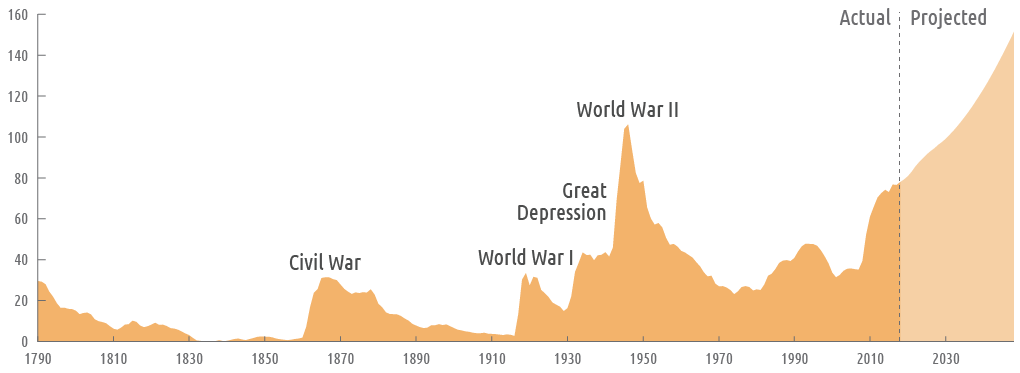
I don't think Alexander is intentionally cherry picking his data. I think he has some epistemic diseases.
First, I don't actually trust any of these numbers.
"Since you are a citizen of a repressive society, you should be extremely skeptical of all the information you get from schools, the media, and popular books on any topic related to the areas where active repression is occurring. That means at least politics, history, economics, race, and gender."
For comparison I looked up Canada's debt and found that everyone is lying about it, and I have no idea how the IMF calculated its numbers. It is not science: it is not verifiable.
The US numbers aren't verifiable either. They're probably being cooked or massaged down the way Financial Post massaged the number up. No disinterested observer would conclude the US government is really only a third of the economy, for example. Add in NGOs and regulatory costs borne by the private sector. Add in decisions 50% controlled by regulation at 50% government action. That's just off the cuff.
Alexander trusts the numbers.
Second, Alexander thinks that numbers can settle questions of interpretation, which, as I have hinted above, they cannot.
Either you think in straight lines or you don't, but in the context of an internet debate, the only way to check is to compare to a known straight-line thinker. Which you can only identify correctly if you think in straight lines in the first place. There's no point in trying to check.
Certainly, if you trust that neither Alexander nor I looked at post-2009 numbers, we can simulate prediction and thus do the ultimate straight-line check. However, that position is immediately vulnerable to any troll who wants to claim they don't trust, as they are indistinguishable from someone who legitimately does not trust.
For example, each time I gather more data, it fits with my previous hypothesis. You could make the argument I'm misinterpreting the data, but that reflects just as badly on Scott Alexander's charts. If they don't support my argument, they don't support his either.
But, if you trust the numbers, and trust they can settle interpretation, then you're not cherry picking: one instance of solid numbers is plenty. Scott Alexander is reasonably good at picking solid number sets.
Third, Alexander has a terrible case of missing the forest.
@Alrenous My initial reaction to Yvain's blog post was "too much object level, not enough meta." Memetics may not be the only example.
— Matt Simpson (@themattsimpson) February 6, 2014
Does it really fucking matter what the debt is? Even on reactionary blogs, isn't this a side show? (I hope it's a side show.) My point is not that debt is going up, my point is that Alexander's reasoning doesn't support his conclusion, suggesting he has a habit of supporting conclusions badly.
The point of the debt argument is democratic(descriptively) government is unsustainable. More broadly, Carlyle was right. As it (apparently) happens, this is manifesting in unsustainable rises in debt.
But it's also manifesting in unsustainable rises in private debt. It's a general culture of imprudence.
Of course, Carlyle is unscientific too. He published his conclusions far more than his reasoning. Were we to try to reconstruct it, we have no way to check we've reconstructed it correctly. But every time he correctly predicts, we should worry a little more about the predictions that haven't quite come true yet for us.
Good luck finding a think-tank publishing an imprudence ratio. Or, even worse, trying to measure how many individuals have destroyed their lives by taking on debt. How many negative utilons, exactly, does 'destroyed' mean?
However, there's no reason in principle both governments and people couldn't have an unprincipled exception and maintain pristine debt records.
The reactionary prediction is that progressive governments will destroy themselves and grievously harm everyone nearby on the way down. That progressivism makes you more imprudent that you would otherwise have been.
The progressive prediction is that they will not only survive, but thrive, and benefit everyone on the way up. That, (for example) we're becoming imprudent because it is no longer necessary to be so prudent. We can chill and everything will be fine.
You cannot correctly distinguish between these predictions based on suicide rate variations on the order of 1%. It doesn't matter how much debt governments hold unless and until they, all of a sudden, are holding too much.
The most important things cannot be measured at all, even in principle.
Saturday, February 22, 2014
Notes on Fascism and the Future 2
Greer talks a strong line about curing the ignorance of the public. I don't think public ignorance is curable. They, quite rationally, don't care enough to do the necessary work. And a 100 IQ means it is a lot of work, even neglecting the greater burden of illusions.
I contrast with one of Nick Szabo's areas of expertise, medieval England, or indeed common law in general.
Jim has said there's one left and a thousand rights. But then 'left' is a code word for proggie and 'right' doesn't mean anything.
This is why it's so hard to make a good argument for Nazism being right or left. It's not progressivism, so it must be right. But it's also highly opposed to conservatism, so it must be left. Or maybe the whole spectrum is a scam and no consistent reading can be got out of it because it's inherently inconsistent.
Of course a good Anarcho-formalist is agnostic about whether totalitarianism is good or bad. Rather this is the first step to discovery: calling things by their right names.
"That last word has been bandied around so freely over the years since then that it’s probably necessary to stop here and discuss what it means. A totalitarian political system is one in which the party in power claims the right to rule every sphere of life: political, religious, artistic, scientific, sexual, and so on through all the normally distinct dimensions of human existence."I have a shorter definition. In a totalitarian state, it is legal for the sovereign to legislate anything. Therefore, democracy is inherently totalitarian. You might retort with 'free speech', but it is legal to amend the constitution. One reason I buy Moldbug's equivalence of National Socialism, Communism, and Democracy is that they share totalitarianism in common.
I contrast with one of Nick Szabo's areas of expertise, medieval England, or indeed common law in general.
"More specifically, it’s supposed to be the far end of that side of the spectrum, the thing that’s more conservative than the conservatives, just as—to the contemporary American right—Communism is the far end of the left side of the spectrum, the thing that’s more liberal than the liberals."Last week I talked about a way AIACC is false. Here is a way it is true. If 'communist' means 'radical left,' then except with reference to the Overton window of 2014 and its intimate neighbours, the Republicants are communist. The Demobrats are infinitesimally more communist.
"These three features are the things that fascist movements and regimes consistently rejected. The first is Marxism, the second liberalism, and the third—the hot-button one—is conservatism."As per last week, right and left are rhetorical traps. Both communists and fascists, in either precise or American meanings, would shriek if subjected to medieval England's legal systems, just as conservatism and fascism can only war with each other. The systems are in the sky or underground somewhere by the left-right coordinate system.
Jim has said there's one left and a thousand rights. But then 'left' is a code word for proggie and 'right' doesn't mean anything.
This is why it's so hard to make a good argument for Nazism being right or left. It's not progressivism, so it must be right. But it's also highly opposed to conservatism, so it must be left. Or maybe the whole spectrum is a scam and no consistent reading can be got out of it because it's inherently inconsistent.
"vied to see who could come up with more excuses for centralizing power in the executive branch of the federal government."Pity Greer missed the memo about bureaucratic government. Perhaps someone more diplomatic than I could forward it to him?
"When Hitler ranted about the will of das Volk, for example, he was simply borrowing Rousseau’s notion of the general will of the people, which both men believed ought to be free from the pettifogging hindrance of mere laws and institutions."Totalitarianism is a legally unconstrained sovereign.
Of course a good Anarcho-formalist is agnostic about whether totalitarianism is good or bad. Rather this is the first step to discovery: calling things by their right names.
"Even to the extent that labels such as “left” and “right” apply to the n-dimensional continuum"First. Less-not-first, at least.
"When fascism succeeds in seizing power, in other words, it’s not a right-wing movement, or for that matter a left-wing one. It seizes the abandoned middle ground of politics,"If Demobrats are left and Republicants are right, then by 'middle ground' he means 'far right,' and also way off to the side. Except for the raisins of radical leftness.
"That’s the secret of fascism’s popularity—and it’s the reason why an outbreak of full-blown fascism is a real and frightening possibility as America stumbles blindly into an unwelcome future."I feel Greer is failing to justify seeing fascism as frightening, or indeed noticeably worse than what democracy descriptively is.
Subscribe to:
Posts (Atom)